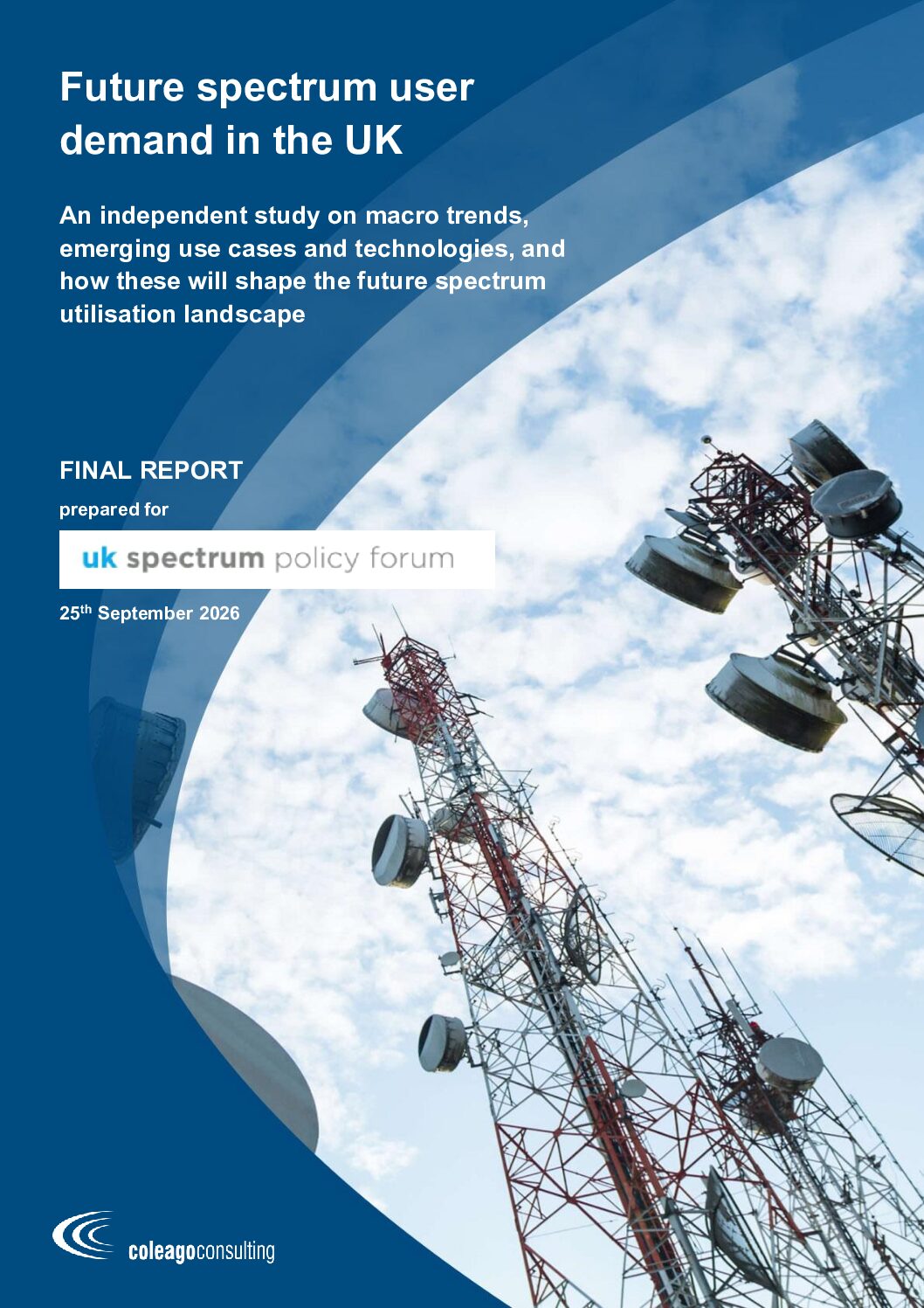
Future Spectrum User Demand in the UK
Over the next 10 to 15 years, UK spectrum demand will be shaped by emerging technologies, connected infrastructure and increasingly diverse wireless applications. This independent study, prepared by Coleago for the UK Spectrum Policy Forum, examines future spectrum requirements across agriculture, energy, aerial communications and emergency services, and explores how flexible spectrum access and sharing can support innovation, economic growth and public safety.
Radio spectrum is a finite national resource underpinning communications, broadcasting, transport, energy, emergency services and an expanding range of industrial applications. As the UK economy becomes increasingly connected and automated, demand for wireless connectivity is expected to grow and diversify significantly over the next 10 to 15 years. This report examines the macro trends, emerging technologies and future applications likely to shape spectrum demand and availability in the UK, and identifies opportunities to maximise the economic and social value of this critical resource.
Emerging pressures on spectrum availability
The study finds that spectrum demand can no longer be assessed solely through conventional measures of mobile data traffic and population coverage. Emerging applications, including connected infrastructure, autonomous systems, industrial automation and remote monitoring, increasingly require reliable connectivity across wider geographical areas, often with demanding requirements for latency, resilience, security and availability.
Pressure is expected to remain particularly acute in frequencies below 10 GHz, which offer an attractive combination of coverage and capacity. The 400 MHz to 1 GHz range is already heavily contested, while demand for spectrum between 3 GHz and 6 GHz is expected to increase as mobile broadband, industrial applications and aerial communications develop.
Technological advances, including 5G-Advanced, 6G, artificial intelligence, non-terrestrial networks and more sophisticated spectrum-sharing technologies, will influence both demand and the efficiency with which existing spectrum resources can be used.
Three emerging use cases
The report examines a broad range of prospective applications before selecting three representative use cases for detailed assessment:
Agritech, telemetry and distributed energy resource management
The increasing use of connected sensors, precision agriculture, livestock monitoring, environmental monitoring and distributed energy systems will create growing demand for reliable, wide-area connectivity, particularly in rural locations.
Although many of these applications generate relatively small volumes of data, their requirements for geographical coverage, device density and dependable communications may not be adequately served by existing commercial networks or spectrum access arrangements.
Aerial platform communications
The anticipated expansion of unmanned aerial vehicles (UAVs), including drones used for infrastructure inspection, logistics, environmental monitoring and public safety, will create new connectivity requirements.
Reliable communications at altitude present challenges that differ from terrestrial network coverage, particularly in relation to interference, network availability and the ability to support beyond visual line of sight operations.
Temporary drone-enabled network extensions
Drone-mounted communications equipment could provide temporary network coverage in emergencies, disaster situations and locations where terrestrial infrastructure is unavailable or damaged.
The study finds that much of the necessary technology already exists. However, regulatory arrangements governing airborne use of licensed spectrum can prevent rapid deployment when connectivity is most urgently required.
Implications for future spectrum policy
A central conclusion of the study is that meeting future connectivity requirements will not necessarily require substantial new spectrum allocations. In many cases, the greater challenge is ensuring that existing spectrum can be accessed more flexibly, efficiently and under conditions appropriate to different applications.
The report identifies several priorities for future UK spectrum policy, including:
- Assessing the potential for shared spectrum access below 1 GHz to support rural monitoring, agriculture and energy applications
- Reviewing licence-exempt spectrum arrangements to improve rural coverage and connectivity
- Developing better measures of machine-to-machine connectivity demand, including device density and simultaneous connections
- Extending mobile coverage assessments to account for aerial users
- Establishing more permanent spectrum arrangements for drone communications and pre-authorised temporary aerial network extensions
- Encouraging greater spectrum sharing while protecting existing services and safety-critical applications
Maximising economic and social value
The study emphasises that the value of spectrum cannot always be measured through traffic volumes or commercial willingness to pay.
Reliable rural connectivity can improve agricultural productivity and environmental monitoring. Better management of distributed energy resources can strengthen electricity network efficiency and resilience. Aerial communications can reduce the cost and risk of infrastructure inspections, while temporary network extensions can improve emergency response and public safety.
These wider economic and social benefits should therefore play an important role in future spectrum policy decisions.
Conclusions
The report concludes that the UK’s future spectrum requirements will be increasingly diverse, geographically dispersed and dependent on service characteristics beyond conventional broadband capacity.
Rather than focusing exclusively on releasing additional frequencies, policymakers and regulators should prioritise improving the evidence base for emerging demand, enabling more flexible spectrum access and supporting practical trials of new sharing arrangements.
By anticipating these requirements before existing access arrangements become a constraint, the UK can support technological innovation, strengthen national resilience and maximise the economic and social benefits derived from its spectrum resources.
The full report provides detailed analysis of emerging technologies, future spectrum demand, selected use cases and recommendations for policymakers, regulators and industry stakeholders.
Other insights
The 5G Divide in Emerging Markets
This White Paper examines the ‘5G Divide’ between Emerging Markets (EMs), through case studies spanning Egypt, Bangladesh, Pakistan, Congo (DRC) and Vietnam. It evaluates the socio-economic costs of delayed spectrum allocation and 5G, as well as the impact of excessive spectrum prices. Finally, it seeks to identify the main steps and policies needed to bridge the 5G gap. We focus on the impact of ‘True 5G’, which is taken to be the deployment of 5G in wide contiguous channels (for high capacity and very high general performance), alongside low-band channels (for wide area coverage and improved cell-edge performance).

US Trade Policy and the Future of the Upper 6 GHz Band
The upper 6 GHz band (6425–7125 MHz) is sought after for both licensed mobile (IMT) and unlicensed Wi-Fi (R-LAN) use. While the Wi-Fi lobby argues that additional spectrum is needed for capacity, US industrial interests are the key driver. This is evident in the 2026 US–Bangladesh trade agreement, which obliges Bangladesh to open the band to Wi-Fi. Given overwhelming reliance on mobile connectivity, in Bangladesh there is no plausible scenario that allocating the upper 6 GHz band to Wi-Fi would generate a greater economic benefit than allocating it to licensed mobile.

Upper 6 GHz for 5G-Advanced and 6G in RCC Countries
This paper was presented at the 30th meeting of the RCC Commission on Radio Spectrum and Satellite Orbits in the panel session “Radiofrequency Spectrum: Needs, Challenges and Opportunities for Timely Implementation of New Technologies”. The presentation was held on the 17th of August 2026 in Cholpon-Ata, Kyrgyz Republic.

Expiring Spectrum Licences in Europe: Renewal, Re-auction, or Alternative Approaches?
As spectrum licences across Europe approach renewal, policymakers face a critical choice between automatic renewal, re-auction or alternative approaches. This presentation examines the European Commission’s proposals, the challenges of renewal pricing and why public interest should be the guiding principle in spectrum licence policy.

Satellite Connectivity and the Operator Challenge
The rapid expansion of low earth orbit satellite constellations and the emergence of direct-to-device connectivity are creating one of the most significant strategic challenges the mobile industry has faced in decades. Satellite operators are evolving from niche providers serving remote areas into potentially powerful competitors capable of delivering broadband and mobile connectivity directly to consumer devices independently of terrestrial infrastructure. Coleago examines the commercial, strategic and regulatory implications of this shift from the perspective of mobile network operators.

Satellite Services and Regulatory Challenges
The rapid emergence of Low Earth Orbit (LEO) satellite constellations and direct-to-device (D2D) technologies is reshaping the communications landscape. Satellite systems are evolving from niche, complementary solutions into mainstream providers of broadband and mobile connectivity, capable of connecting directly to smartphones without intermediary infrastructure. Convergence between satellite and terrestrial mobile networks raises profound regulatory, economic and competitive questions for policymakers worldwide.